

International projects
Turiba University is actively expanding its international cooperation, initiating, developing, and implementing various local, national, and international projects.
We believe that the development of the University is inconceivable without innovative initiatives, the creation of new teaching approaches and methods, and without international collaboration. To prepare high-quality new professionals, it is essential for our university to provide opportunities for learning in an international environment, meeting lecturers, and professionals from around the world. Therefore, we realize international projects in collaboration with universities and partners worldwide.
Through these projects, we have developed new and innovative educational resources and tools, published books, organized international conferences, exchange trips, study visits, summer schools, and other activities.
We have extensive experience in international project management and have been actively involved in coordinating projects such as Central Baltic Interreg, Erasmus Mundus, Erasmus for Young Entrepreneurs program, European Social fund, JUSTICE, NORDPLUS, and ERASMUS+ projects.
Project department initiate and implement projects in collaboration with our faculties and their experts. We are excited to collaborate and bring your ideas to life! Get in touch with us:
KRISTĪNE NEIMANE, Head of project department: kristine.neimane@turiba.lv, Phone: +371 67615541, mob.+371 29628681
IEVA BRUKSLE, Project coordinator: ieva.bruskle@turiba.lv, Phone: +371 67616022
Empowering Neurodiversity in Academia : ENA
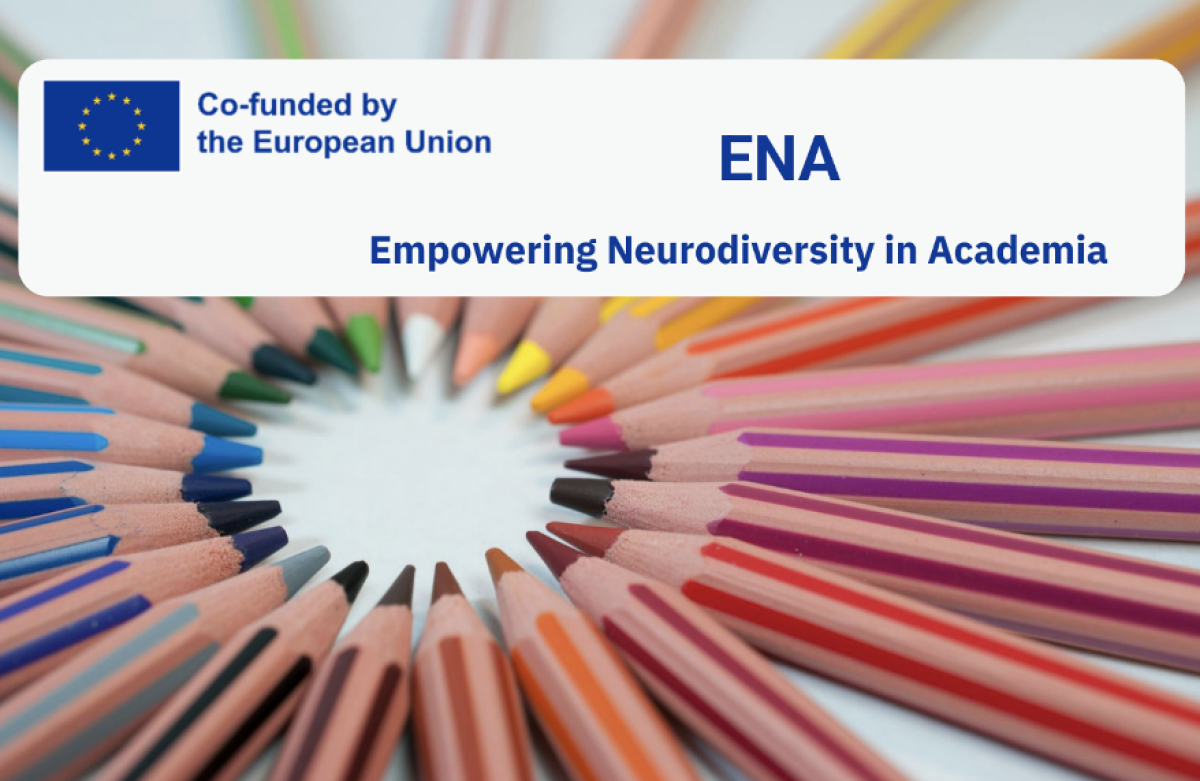
ENA Project – Supporting Neurodiversity Inclusion in Higher Education
In October 2025, Turiba University, in cooperation with the lead partner SMK University of Applied Social Sciences (Lithuania) and higher education institutions from Poland, Germany, Portugal, Cyprus and Spain, launched the Erasmus+ cooperation partnership project “Empowering Neurodiversity in Academia – ENA.” The project aims to foster an inclusive, neurodiversity-affirming learning environment in higher education.
Higher education institutions across Europe are experiencing an increasing need to support students who are neurodivergent (autism spectrum disorder, attention deficit hyperactivity disorder, dyslexia, etc.) or who have invisible disabilities (e.g., mental health challenges, chronic illnesses). For these students, the traditional study environment often creates barriers — sensory overload, difficulties with executive functioning, and insufficient learning adaptations.
At the same time, an increasing number of young people openly acknowledge their learning differences and mental health needs; however, universities are not always sufficiently prepared to support them. In many places, neuroaffirming teaching methods and teacher awareness are lacking, as well as appropriate resources and strategies that ensure an inclusive learning environment.
As a result, some students struggle to engage in the study process, maintain motivation, and successfully complete their studies. This affects not only individual well-being but also the overall quality of higher education, academic outcomes, and institutional social responsibility.
It is essential to systematically review and improve the university learning environment, develop scientifically grounded and inclusive pedagogical approaches, strengthen staff competences, and establish sustainable support systems. This allows universities to become more open, accessible, and flexible, ensuring that every student — regardless of their neurodiversity or health condition — can fully participate in studies and reach their professional potential.
Project Aim
The aim of the project is to create a sustainable and inclusive higher education environment that effectively supports and enhances the educational experiences of neurodiverse students and students with hidden disabilities. This will be achieved through a multifaceted approach encompassing neuro-affirming pedagogical strategies, faculty development and supportive environments.
The ENA project focuses on developing an inclusive higher education system by:
• improving study accessibility for neurodivergent students;
• strengthening teaching staff competences in working with neurodivergent learner groups;
• promoting awareness and an inclusive culture across the university;
• developing practical tools and methodologies for adapting learning environments to the needs of all students.
Expected Results
During the project, the following results will be developed:
- Innovative neuroaffirming teaching materials – methodology, resource sets, and assessment guidelines.
- Teacher training programme – training modules, handbook, and practical guidelines.
- Online Neurodiversity Resource Centre – information, tools, and materials for students and academic staff.
- Awareness-raising campaigns – activities at universities, media outreach, and information events.
- A community and partner network supporting neurodiversity inclusion in higher education.
Partners
- SMK University of Applied Sciences, Lithuania (lead partner)
- WSEI University, Poland
- Fachhochschule des Mittelstandes (FHM), Germany
- Turiba University, Latvia
- Instituto Politécnico de Santarém, Portugal
- University of Nicosia, Cyprus
- Universidad del Atlántico Medio, Spain
Project Implementation Period
📅 01.10.2025 – 30.11.2027
Contacts
📌 Academic Project Leader
PhD Valerija Drozdova
✉️ Valerija.Drozdova@turiba.lv
📌 Project Manager
Mg. oec. Ieva Bruksle
✉️ ieva.bruksle@turiba.lv
📌 The project is implemented with the financial support of the European Union Erasmus+ Programme.
📌 Project No.: 2025-1-LT01-KA220-HED-000364527
📌 Total budget: 400,000 EUR